“No tengo experiencia”: Hidden Talents and the skills young Argentinians don’t know they have
Most young Argentinians who apply to Fundación Empujar start the same way: no tengo experiencia (I haven’t worked). Most of them are wrong. This post introduces Hidden Talents, the World Bank Youth Innovation Fund initiative that built Brújula, the first Spanish-language deployment of Tabiya’s Compass platform, to help youth translate the experience they already have into a skills CV employers trust.
Contributors
Afsana Khan, Jonathan Stöterau



Most young Argentinians who apply to Fundación Empujar arrive with the same answer when asked about their work history: no tengo experiencia (I haven’t worked). Many of them are wrong. They have cared for grandparents through illness. They have run the register at a family kiosk on weekends, helped with catering shifts through a neighbor’s business, or volunteered to construct a community center. The work is real. It just doesn’t look like work for a CV template.
The ILO projects that by 2033 roughly 300 million young people aged 15 to 24 worldwide will not be in education, employment, or training. In Argentina today, one in four young people are unemployed, and roughly 67 percent of those who work do so informally.
Fundación Empujar has been working in this context for over a decade, connecting young Argentinians to employment through its training programs, job portal, and partnerships with business chambers. Its program reaches hundreds of young people each intake, far too many for individual counselling at the standard Empujar maintains. Many of its applicants have real skills but lack credible documentation. But without a structured mechanism to surface it, neither the young person nor Empujar’s coaches can fully use it.
That is where Talentos Ocultos (Hidden Talents) came in. Funded by the World Bank’s Youth Innovation Fund, implemented by Fundación Empujar with Tabiya as technical partner, Hidden Talents brings AI-powered skills recognition into Empujar’s intake process. At its center is Brújula: the Spanish-language adaptation of Tabiya’s open-source Compass platform, and Compass’s first deployment in Spanish.
What Brújula does
Compass is not a new prototype. It is already deployed at scale in South Africa and Kenya, with piloting underway in Zambia. We also conducted a randomized controlled trial in Ethiopia found positive employment outcomes for lower-skilled women. Brújula runs at the intake stage of Empujar’s Tu Empleo program, before training begins. The premise is that many relevant skills of young people from vulnerable backgrounds fall outside traditional work categories. The conversation covers paid employment, self-employment, and training, but its distinctive focus is what we call unseen work: caregiving, household businesses, informal gigs.
Structured follow-up questions draw out experiences applicants would not typically think to mention or may not recognize as valuable. For each experience, the conversation asks what the applicant actually did — the tasks, the responsibilities, the daily reality — and maps those to skills defined in Tabiya’s Inclusive Livelihoods Taxonomy, a classification system built on the European ESCO standard but extended to capture the informal economy. Each label is drawn from a defined taxonomy entry, not generated by the model. The output is a two-page skills CV with a plain-language glossary explaining each skill.
Consider what this looks like in practice. A young woman arrives at intake. Since high school, she has been caring for her grandmother through illness and did occasional babysitting for families in the neighborhood. She says she hasn’t worked. Brújula translates those experiences into skills that hiring managers recognize: responsibility, time management, childcare, communication, and reliability. Each label comes with a short description of what she actually did to develop it. She walks out of intake with a CV she can defend in an interview.
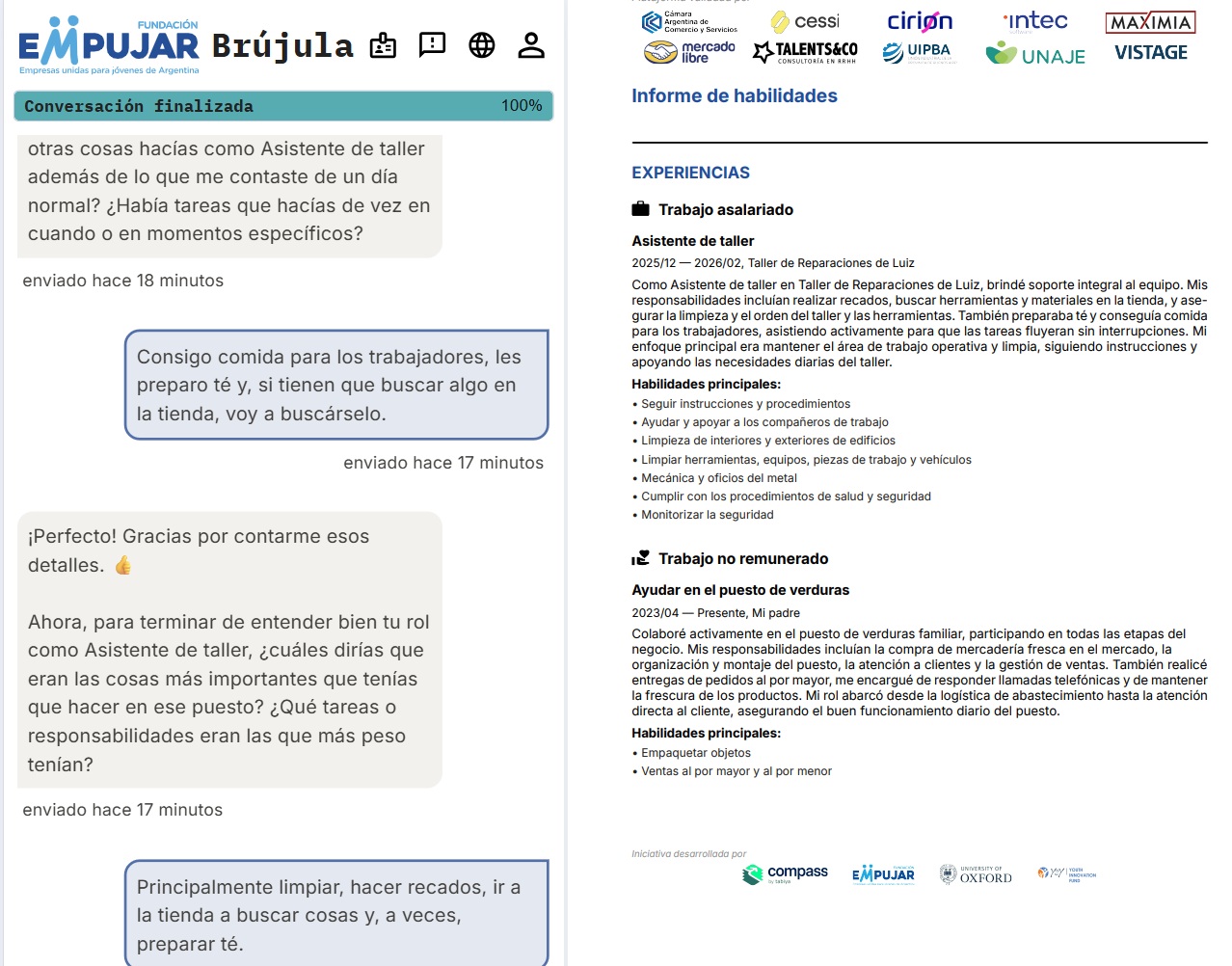
Example of Brújula Conversation and CV
Why employers accept it
A skills CV is only as useful as the trust employers put in it. Building that trust is the hardest part of this kind of work in labor market intermediation, and the part most AI hiring tools targeted towards jobseekers quietly skip.
We took a different route. Through pre-pilot tests, the Hidden Talents team brought draft versions of Brújula’s conversation and outputs to major Argentine employer chambers and firms in Empujar’s network. Employers told us the transversal skills were being extracted too granularly; we aggregated them. They asked for a format that fit Argentine hiring conventions; we redesigned it. The conversation was shortened, simplified, localized in register, and tuned to handle applicants with no formal work history.
These rounds of iteration produced a skills-extraction methodology that has been formally endorsed by those same employers. Every Brújula CV carries their logos in a “validated by” header. Employers get a document they can act on. Participants get a report with institutional weight that neither Tabiya nor Empujar could confer alone.
That skills report feeds directly into the rest of Tu Empleo, making it available to Empujar’s coaches to shape training and placement decisions from day one. Participants use it when preparing for interviews and applying for roles in Empujar’s employer network. It works in two directions: it gives coaches a more complete picture of each candidate, and it gives participants a way to see and name their own competencies in language they can use throughout the program.
Where we are now
Brújula is live. Applicants selected for Empujar’s February 2026 cohort are completing the Brújula conversation at intake, and the resulting skills reports are now in use by participants and coaches alike. Applicants not selected for the cohort are also using Brújula as part of an independent impact evaluation led by Jasmin Baier from the University of Oxford, Chiara Malavasi, and Celina Proffen. The research was designed to capture outcomes across both supported and unsupported youth and to measure not just employment but intermediate steps on the way: skills, self-awareness, confidence, and job-search behavior.
Over the coming months, Hidden Talents will close out Phase 1 in mid-2026 with a final round of refinements informed by the cohort and a career fair “Expo Empleo” being launched for May 2026, reaching 3000+ youth and 20+ employers. Partner employers and youth will get the opportunity to try out Brújula live at the expo. Phase 2 will scope deeper integration with Empujar’s placement pipeline, including Tabiya’s Horizon skills-matching layer, and regional replication with additional implementing partners across Latin America.
Want to follow along?
Brújula is built on Tabiya’s open-source Compass platform, available on GitHub. If you’re working on skills discovery or career navigation for youth in the region, or want to follow the evidence as results from the evaluation come in, we’d love to hear from you. Reach us at hi@tabiya.org or follow us on LinkedIn.